


Ayurveda 2025: From Tradition to Global Systems Science
The December 2025 issue of Ayurveda Post has been conceived not as a routine year-end newsletter, but as a global yearbook. It documents a year in which Ayurveda crossed a historic threshold, moving decisively from cultural recognition to systems-level engagement across policy, science, digital health, education, public health, industry, and global discourse.
What unites the diverse developments of 2025 is not speed or scale, but maturity. Across continents and institutions, Ayurveda was no longer asked to merely justify its existence. Instead, it was invited to demonstrate responsibility: intellectual, scientific, ethical, and systemic.
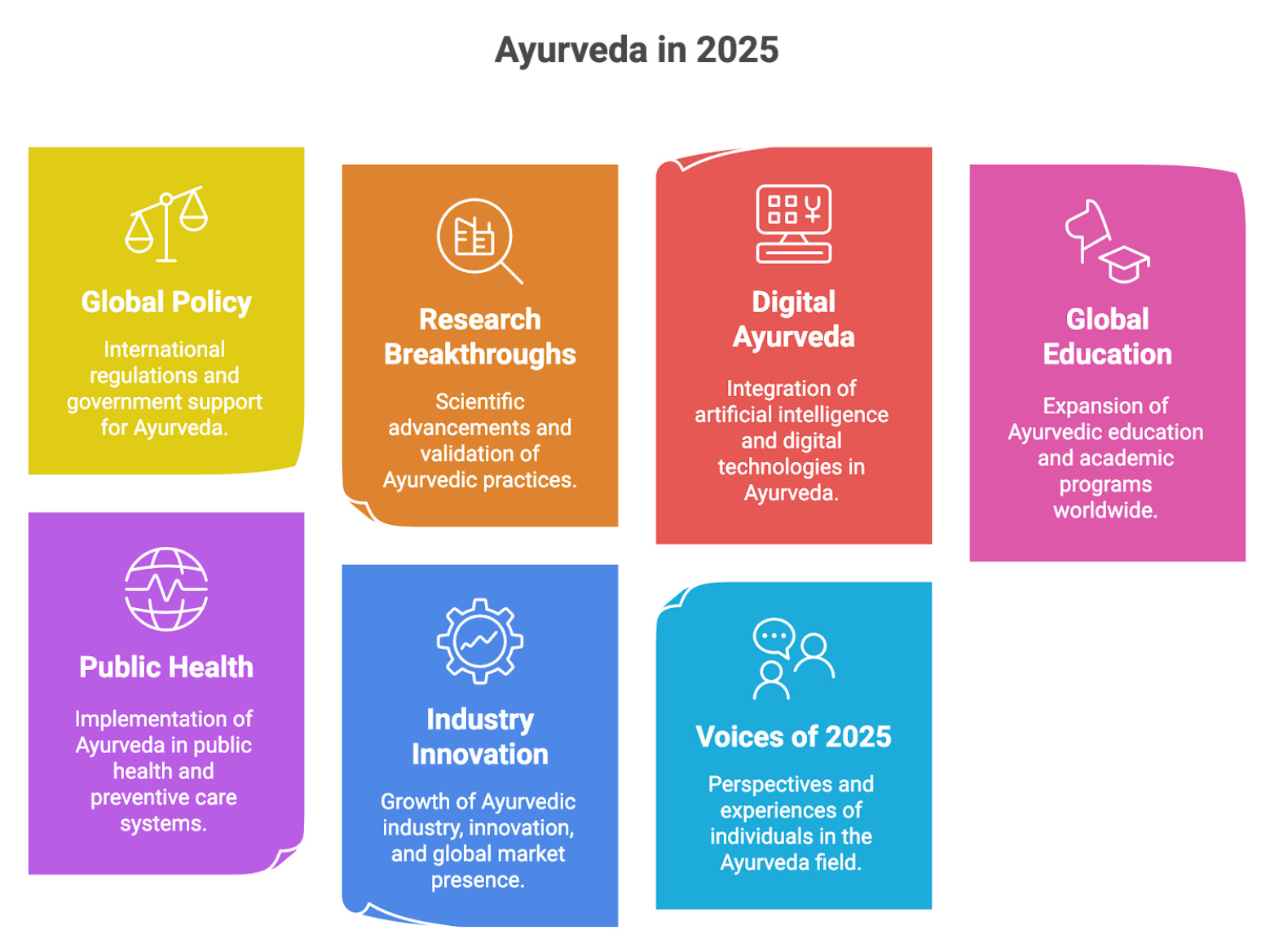
This issue reflects on seven defining currents that shaped Ayurveda’s global journey in 2025.
1. From Recognition to Governance in Global Policy
2025 will be remembered as the year Ayurveda became structurally visible within global health governance. With the adoption of the Global Traditional Medicine Strategy 2025–2034, inclusion in the ICD-11 Traditional Medicine module, and high-level technical dialogues, Ayurveda moved from advocacy to implementation readiness.
This shift matters because it embedded Ayurveda within formal global health architecture, opening pathways for data reporting, research analytics, reimbursement discussions, and regulatory coherence. The emphasis was clear: legitimacy comes not from symbolism, but from governance. READ MORE
2. From Reductionism to Systems Science in Research
Ayurveda research in 2025 matured beyond the question of ‘does it work?’ toward the more meaningful inquiry of how it works as a complex, adaptive medical system.
The year saw increased adoption of systems biology, network pharmacology, prakriti-based stratification, pragmatic trials, and real-world evidence, alongside convergence with microbiome science, metabolomics, and epigenetics. Importantly, this scientific alignment did not demand epistemological dilution. Instead, it reinforced the idea that Ayurveda must be studied on its own theoretical terms, using appropriate and pluralistic research methods. READ MORE
3. From Digital Experiments to Health-System Infrastructure
Digital Ayurveda underwent a quiet but profound transformation in 2025. The narrative shifted away from isolated apps and experimental tools toward interoperable, accountable digital infrastructure.
Milestones such as ICD-11 digital readiness, integration pathways with national digital health missions, global conversations on AI governance, and the launch of the WHO Traditional Medicine Global Library (TMGL) collectively reframed Digital Ayurveda as a matter of trust, data integrity, and system design.
AI, in this context, was no longer positioned as a replacement for clinical reasoning, but as an assistive layer that must operate under ethical and clinical governance. READ MORE
4. From Informal Learning to Global Academic Legitimacy
Global Ayurveda education reached a turning point in 2025. The focus shifted from short-term exposure and cultural curiosity toward formal degree pathways, curriculum rigor, research linkage, and academic accountability.
Cross-border faculty exchanges, joint research supervision, and globally aligned curricula began shaping a new generation of clinicians, educators, and researchers. Ayurveda entered global classrooms not as fragmented techniques, but as a coherent, teachable, and researchable knowledge system. READ MORE
5. From Individual Therapy to Population Health
In public health discourse, Ayurveda in 2025 was increasingly framed as a preventive and promotive health system, relevant to non-communicable diseases, mental health, lifestyle disorders, and aging populations.
Its principles of dinacharya, ritucharya, ahara, and vihara aligned naturally with global prevention priorities. Community-based lifestyle interventions and integration discussions with primary healthcare systems highlighted Ayurveda’s potential contribution at population scale, provided it is standardized, monitored, and ethically implemented. READ MORE
6. From Fragmented Markets to a Regulated Global Industry
The Ayurveda industry crossed a critical threshold in 2025. Global trust began favoring research-led, compliance-ready, and sustainability-conscious ecosystem builders over short-term product sellers.
Innovation increasingly focused on translational research, quality assurance, traceability, ethical sourcing, and digital platforms that support clinical, educational, and regulatory needs. Ayurveda’s future in global markets was no longer framed by volume alone, but by credibility, safety, and stewardship. READ MORE
7. From Advocacy to Thought Leadership: The Voices of 2025
Finally, 2025 was shaped by voices that spoke with restraint and clarity. From the 2nd WHO Global Summit on Traditional Medicine in New Delhi, global leaders, scientists, clinicians, educators, and policymakers converged on a shared understanding:
Integration is a systems challenge, not a cultural debate
Evidence must be rigorous, yet epistemologically fair
Education determines credibility
Innovation demands ethical restraint
The full addresses of Prime Minister Narendra Modi and WHO Director-General Dr. Tedros Adhanom Ghebreyesus crystallized this moment, signaling a global commitment to move from dialogue to action.
PM’s address at the 2nd WHO Global Summit on Traditional Medicine
Taken together, these seven currents define why 2025 stands apart in Ayurveda’s global journey. Ayurveda did not become louder this year. It became more serious.
It stopped asking for space and began earning trust through governance, science, education, digital responsibility, public health relevance, industrial maturity, and thoughtful leadership.
This December 2025 issue of Ayurveda Post stands as a record of that transition. More importantly, it serves as a reminder that Ayurveda’s future will not be shaped by speed or scale alone, but by stewardship, coherence, and conscience.
Wish you a very Happy New Year 2026
Prof Abhimanyu Kumar
Chief Editor, Ayurveda Post
CAYEIT | December 2025
This feels like a much-needed and timely articulation of where Ayurveda truly stands today. Not as a relic to be defended, but as a mature, living system ready for responsibility at a global level. The shift from validation to contribution is powerful. What resonates most is the emphasis on ethics, systems thinking, and scientific dialogue without losing its philosophical core. This is how Ayurveda earns trust — by depth, discipline, and quiet confidence, not noise.