


Welcome to Ayurveda Post, January & February 2026 makes one thing clear: traditional medicine is entering a standards-and-systems era.
The Delhi Declaration sets the policy direction, Europe and Australia show how regulation turns that direction into practice, and North America reminds the world that safety credibility is earned through surveillance and enforcement.
In 2026, the leaders will be those who can prove four basics: reproducible quality, evidence-aligned claims, transparent safety monitoring, and competency-based training.
Ayurveda can lead this moment by operationalizing tradition through measurable standards, not by asking the world to accept tradition as the argument.
Chief Editor
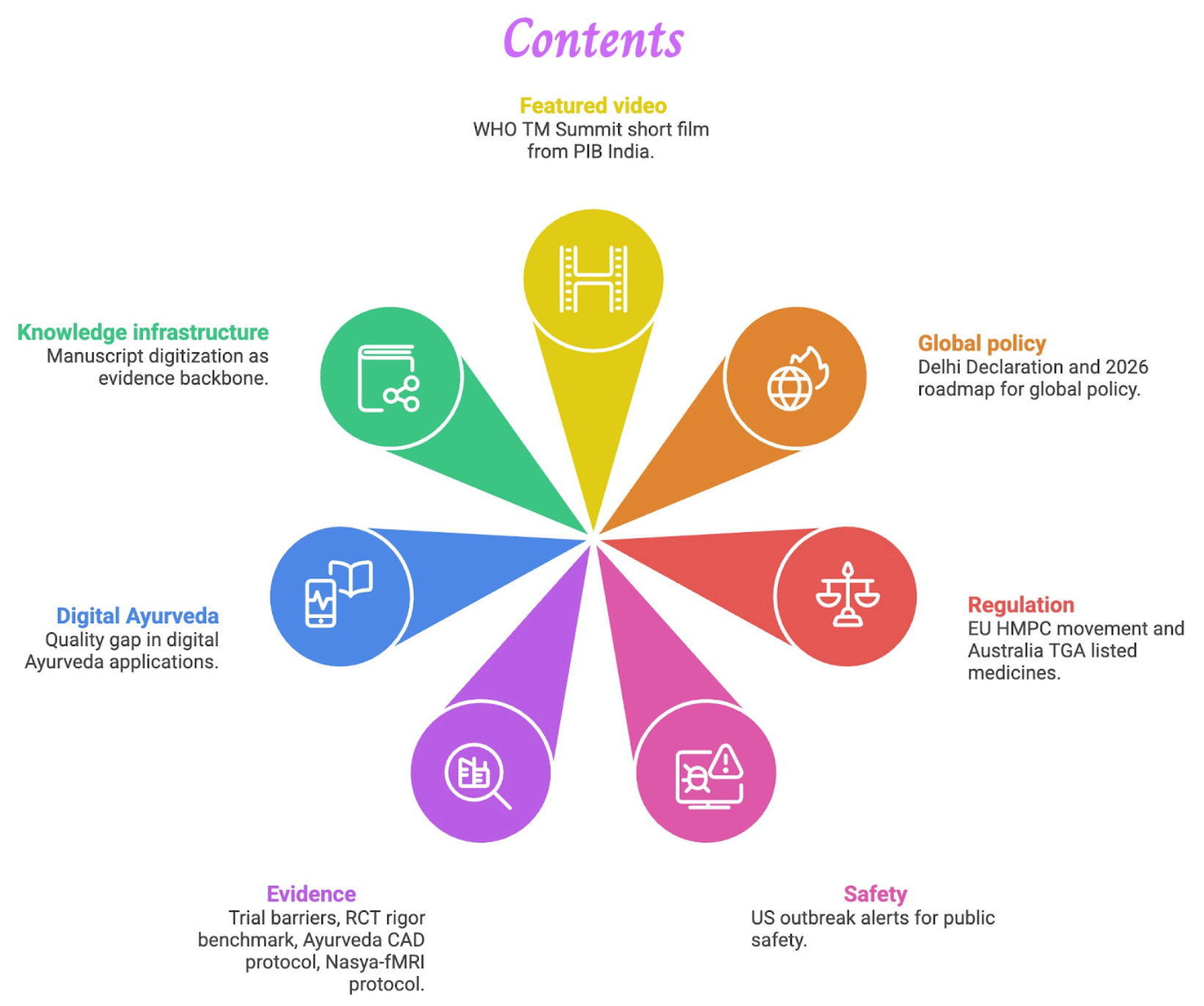
Featured Video clip
Watch a short film on the Second WHO Global Summit on Traditional Medicine” posted by PIB India on Facebook

Global policy and multilateral coordination
WHO summit outcome becomes the 2026 roadmap for traditional medicine
The biggest policy signal shaping 2026 is the outcome of the Second WHO Global Summit on Traditional Medicine (New Delhi, 17–19 Dec 2025). The Delhi Declaration outlines a practical direction: strengthen the evidence base (including digital knowledge infrastructure), tighten safety and quality systems through risk-based regulation, and support integration into health systems through standards, guidelines, and workforce development. For Ayurveda stakeholders, this becomes the key alignment anchor for 2026: education, clinical protocols, product dossiers, and research programs will increasingly be judged by governance, reproducibility, and patient-safety systems, not by tradition alone.
Regulation and market access
Europe’s herbal rulebook keeps evolving through EMA HMPC work
The European Medicines Agency published materials for the Committee on Herbal Medicinal Products (HMPC) meeting (19–21 Jan 2026), reflecting continued work on herbal monographs and EU positioning for botanicals. The HMPC agenda and the HMPC Work Plan 2026 indicate steady movement toward consistent scientific evaluation, stronger internal frameworks, and ongoing method development for herbal assessments. For Ayurveda brands and researchers targeting Europe, this matters because EU monograph logic influences how claims are framed (traditional-use boundaries versus stronger evidence expectations), what quality data is expected, and how safety signals are handled.
Australia updates its listed-medicines guidance and hardens compliance priorities
Australia’s Therapeutic Goods Administration updated the Australian Regulatory Guidelines for Listed Medicines (ARGLM) and issued compliance principles for 2026–2027 that emphasize proactive, risk-based enforcement, including advertising-related compliance. For herbal and traditional products sold as listed medicines, the signal is clear: regulators expect stronger sponsor accountability, clearer consumer-facing communication, and sharper enforcement readiness. For Ayurveda exporters, Australia serves as a useful future mirror for what many mature markets are building: higher discipline on labelling, claims, and post-market compliance.
Safety, quality systems, and pharmacovigilance
US safety alert: Salmonella outbreak tied to moringa and “greens” supplement products
The U.S. Food and Drug Administration posted an outbreak investigation update advising against recalled dietary supplement products containing moringa leaf powder. The Centers for Disease Control and Prevention also reported outbreak totals and evidence linking contaminated moringa leaf powder to illnesses. The broader takeaway is direct and global: credibility now depends on microbiological controls, supplier audits, lot traceability, and recall readiness for herbal powders.
Clinical research and evidence standards
Reality check for herbal research: why trials struggle and what to fix
A peer-reviewed article in Frontiers in Pharmacology lays out concrete barriers to herbal clinical research across Switzerland and the UK: product standardization constraints, feasibility gaps between real-world practice and full trial requirements, regulatory expectations, manufacturing controls, and operational trial logistics. This is especially relevant for an evidence-forward Ayurveda lens because it clearly shows where studies commonly fail: inconsistent product identity, unclear dosing rationale, weak comparators, and inadequate reproducibility safeguards.
Rigor benchmark: triple-blind, placebo-controlled herbal RCT in asthma
A paper in Advances in Integrative Medicine reports a triple-blind, placebo-controlled randomized clinical trial of a standardized herbal sachet as adjunct therapy in mild-to-moderate asthma, with reported improvements in asthma control metrics. Although it is not Ayurveda-specific, it remains a valuable benchmark for trial-grade rigor: triple blinding, placebo control, standardized preparation, and structured outcomes. In a global environment shaped by the Delhi Declaration, Ayurveda research that mirrors this level of design rigor can travel farther, earning clearer evidence grading, higher publication acceptance, and stronger regulator trust.
Ayurveda trial design moving toward mainstream clinical expectations: CAD protocol
A study protocol in BMC Complementary Medicine and Therapies describes a double-blind randomized controlled design evaluating Ayurveda interventions (Pushkar Guggulu and Haritaki) as an adjunct to standard care in stable coronary artery disease, including clinical endpoints and safety labs. Protocol papers like this matter because they show methodological intent before results are available: endpoints, randomization, and monitoring plans are transparent and auditable. It is a signal of direction, showing that Ayurveda research is increasingly adopting globally recognizable trial scaffolding.
Neuro-Ayurveda moves toward measurable mechanisms: Nasya plus fMRI protocol
A PubMed-indexed protocol describes an exploratory randomized trial aiming to map neurophysiological response to Nasya karma using blood-oxygen-level dependent fMRI, alongside measures for quality of life, cognition, sleep, and psychological well-being in healthy volunteers. Mechanism-oriented protocols are valuable because they help bridge understanding across medical systems without overclaiming clinical efficacy. In policy terms, they fit the Delhi Declaration’s direction: strengthen evidence using appropriate scientific tools and improve confidence through transparent methods.
Digital Ayurveda and product quality
Systematic review flags a quality gap in Ayurveda smartphone apps
A European Journal of Integrative Medicine systematic review evaluates Android Ayurveda apps using a structured rating approach and reports that many apps are low-to-moderate quality, calling for evidence-based, user-centric development. For an innovation-focused newsletter, this supports a clear position: digital Ayurveda must meet health-tech expectations of quality, transparency, and safety, rather than functioning primarily as content repositories.
Knowledge preservation
Protecting classical knowledge at scale: CCRAS and Berhampur University digitization MoU
A formal MoU between the Central Council for Research in Ayurvedic Sciences and Berhampur University aims to digitize, catalogue, and publish rare Ayurvedic manuscripts and related materials, including a descriptive catalogue framework intended to make collections systematically usable for researchers. This story is bigger than preservation. Digitization becomes evidence infrastructure: searchable corpora, citation-ready references, and faster translation of classical concepts into research questions, curricula, and public education. It is best understood as knowledge governance, not only archiving.
AIIA-CAYEIT MoU Signed in New Delhi to Advance AI-Enabled Ayurveda (27 January 2026)
On 27 January 2026, the All India Institute of Ayurveda (AIIA), New Delhi signed a Memorandum of Understanding (MoU) with the Centre for Ayurveda Education, Innovation & Technology (CAYEIT), marking a new step toward strengthening digital innovation and evidence-building in Ayurveda. According to the official release, the collaboration focuses on cutting-edge research, technology transfer, and innovative educational frameworks in Ayurveda. It is positioned as a blend of AIIA’s clinical strengths and CAYEIT’s technology capabilities to help translate Ayurvedic knowledge into globally usable solutions. Where the ceremony took place
This MoU is a practical signal that Ayurveda’s next growth phase will be built on clinical-grade implementation + digital capability: better data structures, clearer research translation, and modern education models that make Ayurveda easier to validate, understand, and scale responsibly.

READ MORE: (Press Information Bureau)
2026 is a clear reminder: Ayurveda’s global leadership will be earned through quality systems, credible evidence pathways, and safety-first transparency, not heritage alone.
CAYEIT helps translate Ayurveda’s classical foundations into globally legible systems: reproducible quality frameworks, evidence-first research pathways, and safety-centered governance. We support practitioners and innovators with tools, standards, and training that enable Ayurveda to scale with credibility.
We welcome your inputs and suggestions. contact@cayeit.com
Ayurveda Post
Editorial Team
CAYEIT is demonstrating Excellent leadership and long needed rhetoric for traditional medicine. By stepping into the new honoring the tradition, we build new cultures and ecosystems of excellence. Thank you for your work.